

Land use requirements can change as a project develops. An area initially reserved for storage may later become a parking zone, an internal access road or an extension of the main facility. A folding precast compound wall offers a practical boundary solution for sites where flexibility, organised installation and efficient use of materials are important.
Unlike a conventional brick wall constructed entirely at the site, a precast wall is assembled using factory-manufactured concrete components. Depending on the selected system, these components can be installed in a modular arrangement that simplifies planned dismantling, relocation or reconfiguration. This makes the solution relevant to industrial plots, warehouses, construction sites, institutions and large private properties.
How a Folding Precast Wall Works
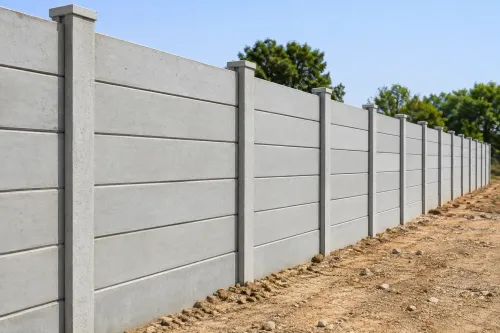
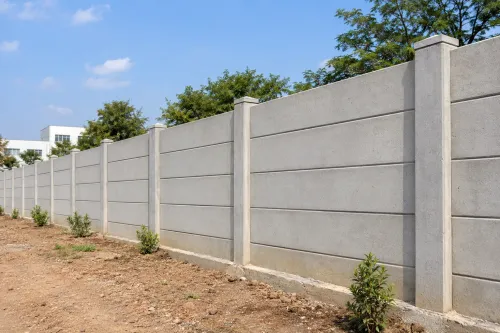
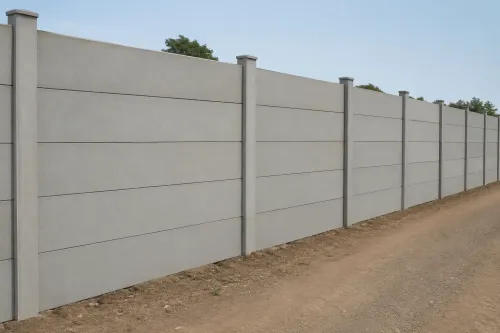
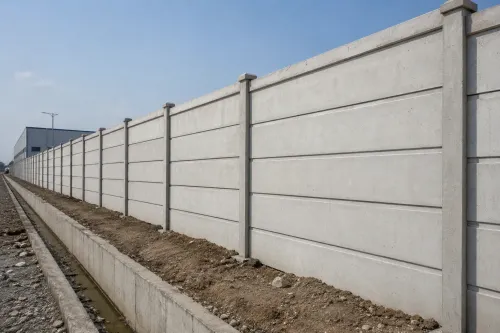
A typical precast compound wall system consists of reinforced concrete posts and panels. The posts are installed at calculated intervals, while panels are fitted between them to form a continuous barrier. In a folding or modular configuration, the layout is planned to facilitate component-wise handling.
The exact design depends on several factors:
- Required wall height and length
- Soil and foundation conditions
- Expected wind exposure
- Security requirements
- Available installation space
- Future plans for the property
- Vehicle and equipment movement around the boundary
A site assessment is essential because the same wall configuration may not be suitable for every plot.
Where This Boundary System Is Useful
Folding precast walls are particularly suitable when the land layout may change over time. For example, a manufacturing unit may need to extend its production shed, while a developer may divide a large property into phases before beginning construction.
Common applications include:
- Temporary or semi-permanent construction boundaries
- Industrial plot demarcation
- Warehouse and logistics premises
- Agricultural and farmhouse properties
- Educational campuses
- Material storage yards
- Infrastructure project sites
- Vacant plots awaiting development
For growing industrial areas around Nashik, Maharashtra, modular boundary systems can support phased site development without requiring a completely new wall whenever the layout changes.
Key Advantages of a Modular Design
One of the main advantages is installation efficiency. Because the major components are produced before reaching the site, the amount of masonry work required at the property is reduced. This may help maintain a cleaner work area and limit dependence on prolonged bricklaying and plastering activities.
Other practical benefits include:
- Consistent panel dimensions
- Predictable material requirements
- Reduced on-site curing work
- Faster boundary formation
- Easier replacement of individual damaged components
- Potential for reuse when the system is designed accordingly
- Neat and uniform visual appearance
Silicon Precast manufactures precast boundary components for different property and project requirements in Nashik. The suitability of a folding arrangement, however, should be evaluated according to the intended period of use, terrain and structural requirements.
Important Planning Considerations
A modular wall should not be treated as a one-size-fits-all product. Before installation, the site team must confirm boundary lines through an appropriate survey. Local development regulations, access requirements and neighbouring properties should also be considered.
Ground preparation deserves equal attention. Uneven land, loose soil, waterlogging or significant level differences can affect post placement and overall stability. Drainage routes should remain unobstructed, particularly during Nashik’s monsoon season.
The handling process also matters if future relocation is expected. Panels must be lifted, transported and stored carefully to avoid cracking or edge damage. Reusability depends not only on the product but also on correct installation and subsequent handling.
A folding precast compound wall is most effective when flexibility is considered from the design stage. With accurate measurements, suitable foundations and properly manufactured components, it can provide a structured boundary while accommodating future changes to the site.